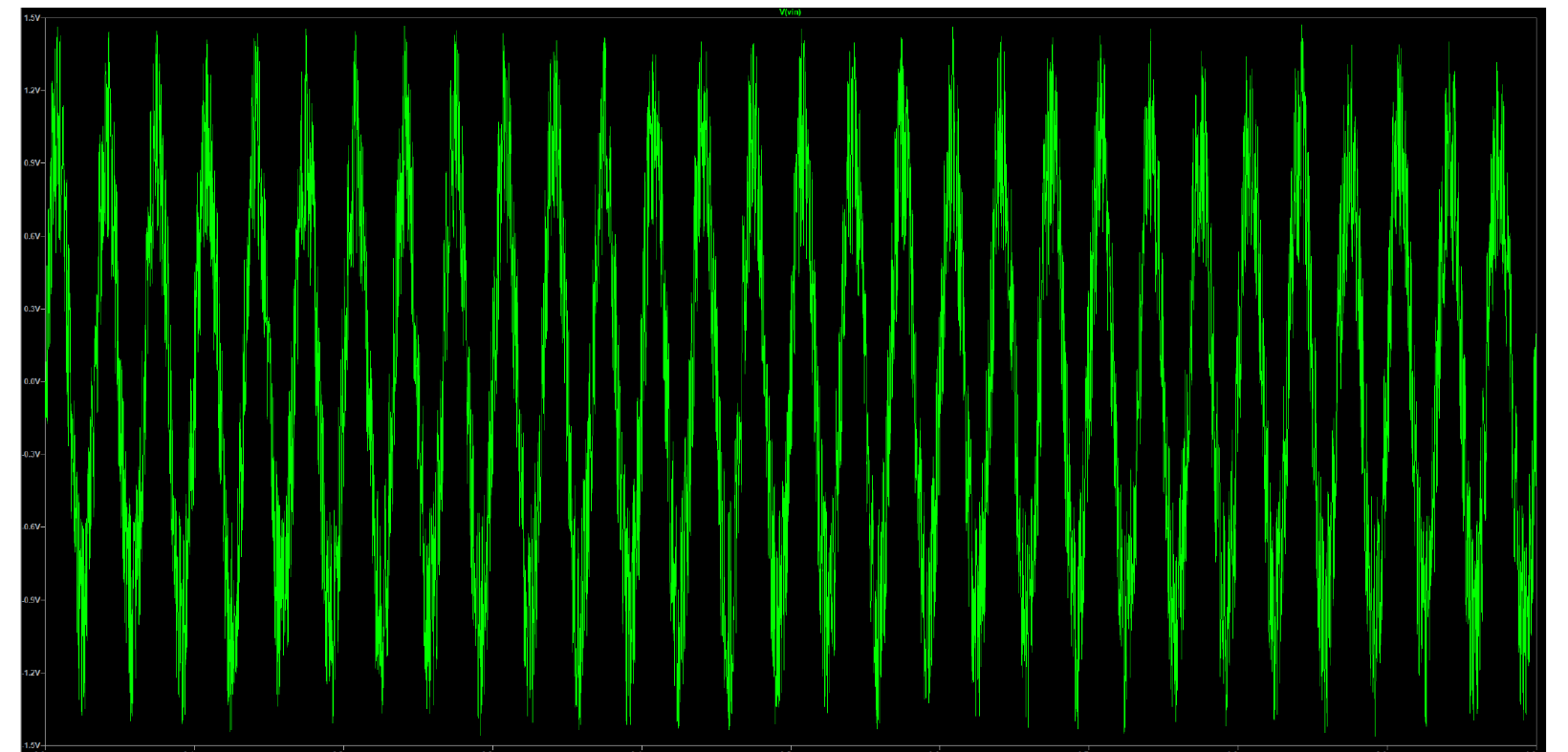
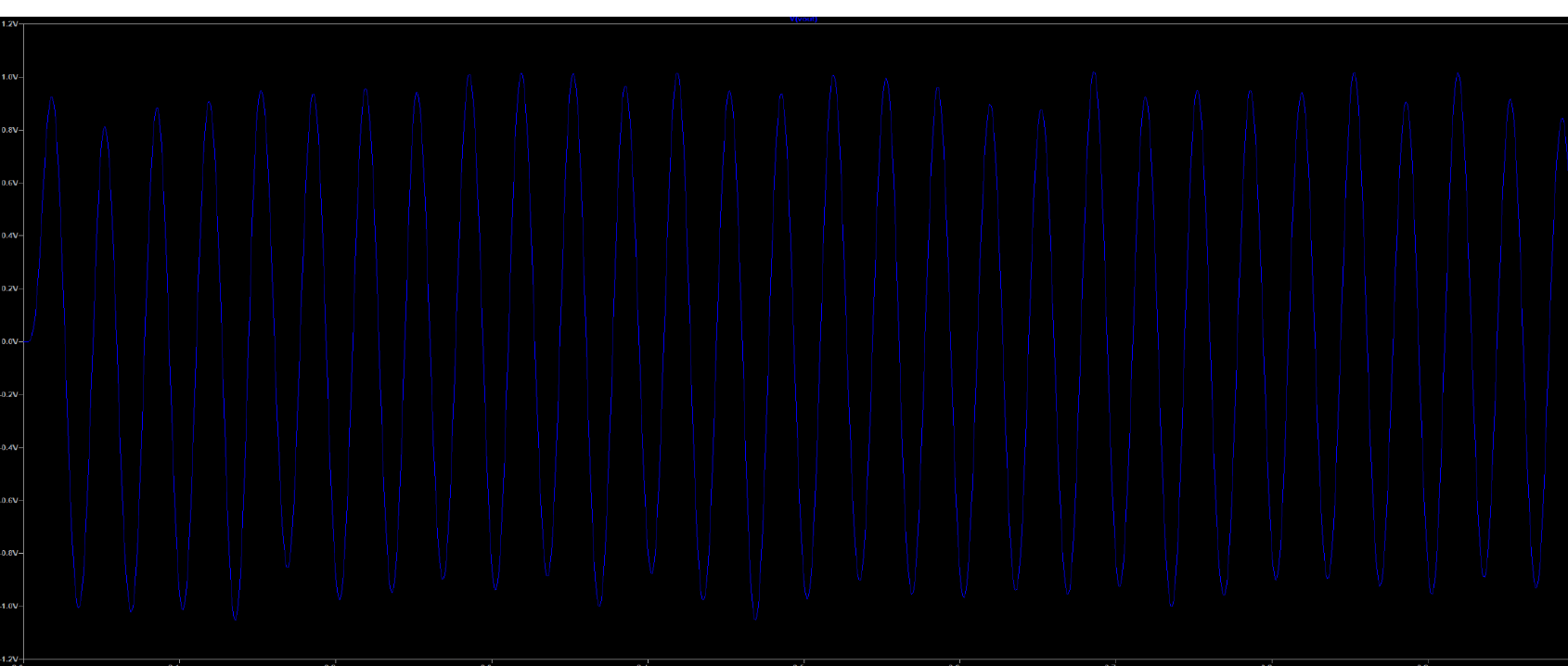
An 8th-order band-pass filter built by cascading a 4th-order high-pass and a 4th-order low-pass biquad section, giving a 1 kHz to 50 kHz passband with more than 45 dB of stopband attenuation.
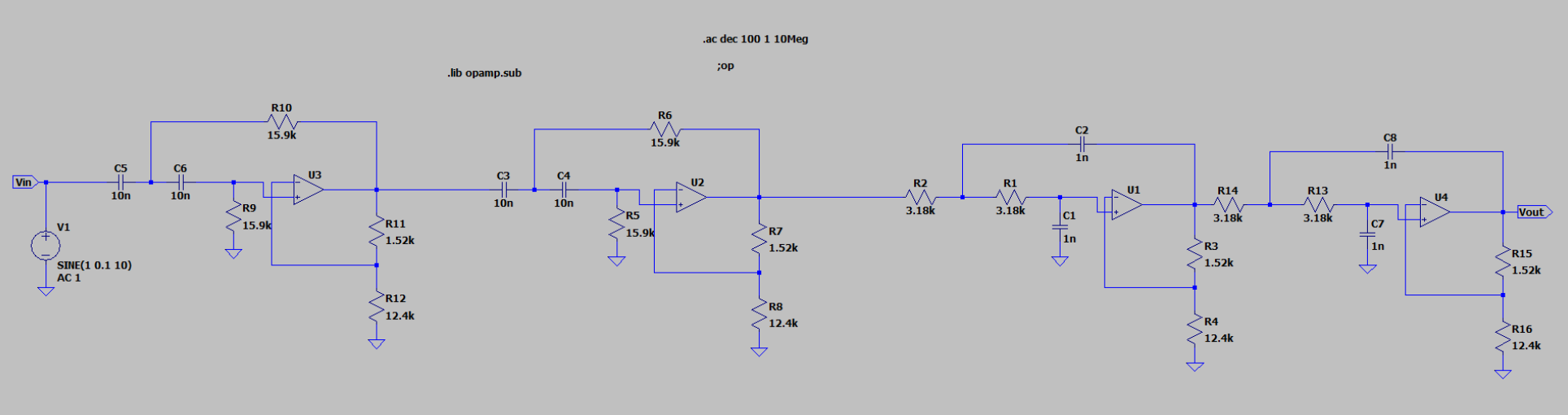
LTspice schematic of the 8th-order band-pass filter: four Sallen-Key op-amp stages in series, two high-pass sections with 15.9 kilohm resistors and 10 nanofarad capacitors followed by two low-pass sections with 3.18 kilohm resistors and 1 nanofarad capacitors, each stage set by a 1.52 kilohm and 12.4 kilohm gain divider
The cascade in LTspice: two high-pass Sallen-Key sections (15.9 kΩ, 10 nF) into two low-pass sections (3.18 kΩ, 1 nF), each stage's gain set by the 1.52 kΩ and 12.4 kΩ divider.
StageComponentsGain
High-pass (4th order)\(R = 15.9\ \mathrm{k\Omega}\), \(C = 10\ \mathrm{nF}\)\(K_1 = 1.152\)
Low-pass (4th order)\(R = 3.18\ \mathrm{k\Omega}\), \(C = 1\ \mathrm{nF}\)\(K_2 = 2.235\)

Stability was checked by solving each biquad's pole locations analytically and confirming all poles lie in the left half s-plane, then validating with a transient step response that decayed without oscillation.

The design was verified in LTspice with AC analysis from 1 Hz to 10 MHz and transient simulation, recovering a clean 30 kHz tone from a white-noise-corrupted input.
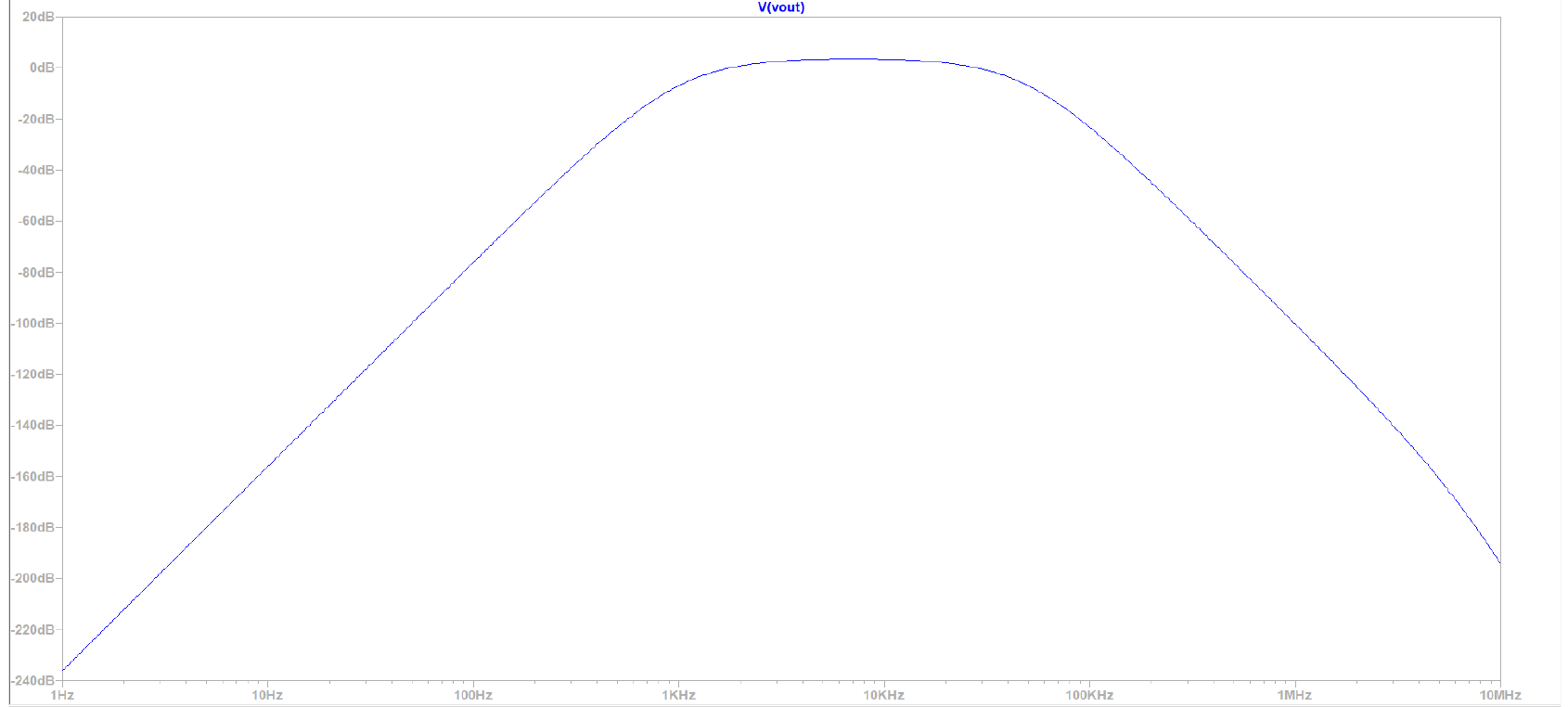
LTspice AC sweep of the filter output from 1 Hz to 10 MHz, showing a flat passband near 0 dB between about 1 kHz and 50 kHz with steep roll-off on both sides
AC sweep, 1 Hz to 10 MHz. The response is flat across the 1 kHz to 50 kHz passband and falls away steeply on both skirts, past 45 dB down in the stopbands.

Noise rejection test

Transient plot of the noisy input: a 30 kHz sinusoid buried in broadband white noise, appearing as a thick jagged green band
Input: a 30 kHz tone combined with two white-noise sources.
Transient plot of the filter output: a clean periodic 30 kHz sinusoid with the broadband noise removed
Output: the same tone recovered, broadband noise removed.
LTspiceSallen-Key Biquad cascadePole placement Noise rejection