Design and analysis of the key components in a fiber-optic link: launching light into multimode fiber, handling random polarization, modulating a binary signal, and recovering it at a photodiode. Four linked tasks that build into one end-to-end system.
Task 1: Fiber coupler
Single-lens system launching a laser into 50 µm multimode fiber (\(n_1 = 1.5\), \(n_2 = 1.49\), lens \(F = 3.5\ \mathrm{mm}\), \(D = 2\ \mathrm{mm}\)).
| Quantity | Result |
|---|---|
| Numerical aperture | \(\mathrm{NA} = 0.1729\) |
| Acceptance angle | \(\theta_{\max} = 9.96^{\circ}\) |
| Max coupling radius | \(r_{\max} = 0.6147\ \mathrm{mm}\) |
| Power coupling efficiency | \(\eta \approx 37.79\%\) |
Efficiency is limited because the lens focuses rays across a wider angular spread than the fiber's acceptance cone will admit.
Task 2: Revised three-lens coupler
Redesigned with a three-lens arrangement that shrinks the beam so every ray arrives within \(\theta_{\max}\), recovering the lost power.
| Quantity | Result |
|---|---|
| Required beam radius at L₃ | \(r_3 = 0.3511\ \mathrm{mm}\) |
| Lens separation | \(d_1 = 4.729\ \mathrm{mm}\) |
| Collimating lens focal length | \(F_2 = 1.229\ \mathrm{mm}\) |
| Radius of curvature (plano-convex) | \(R = 0.6145\ \mathrm{mm}\) |
Task 3: Random polarization through a polarizer
Malus's law applied to a randomly polarized source. Analytically, for \(\theta\) uniform over \([0, 2\pi]\), the expected transmission \(E[\cos^{2}\theta] = \tfrac{1}{2}\). A 1,000,000-sample Monte Carlo simulation returned 0.5001, confirming the result.
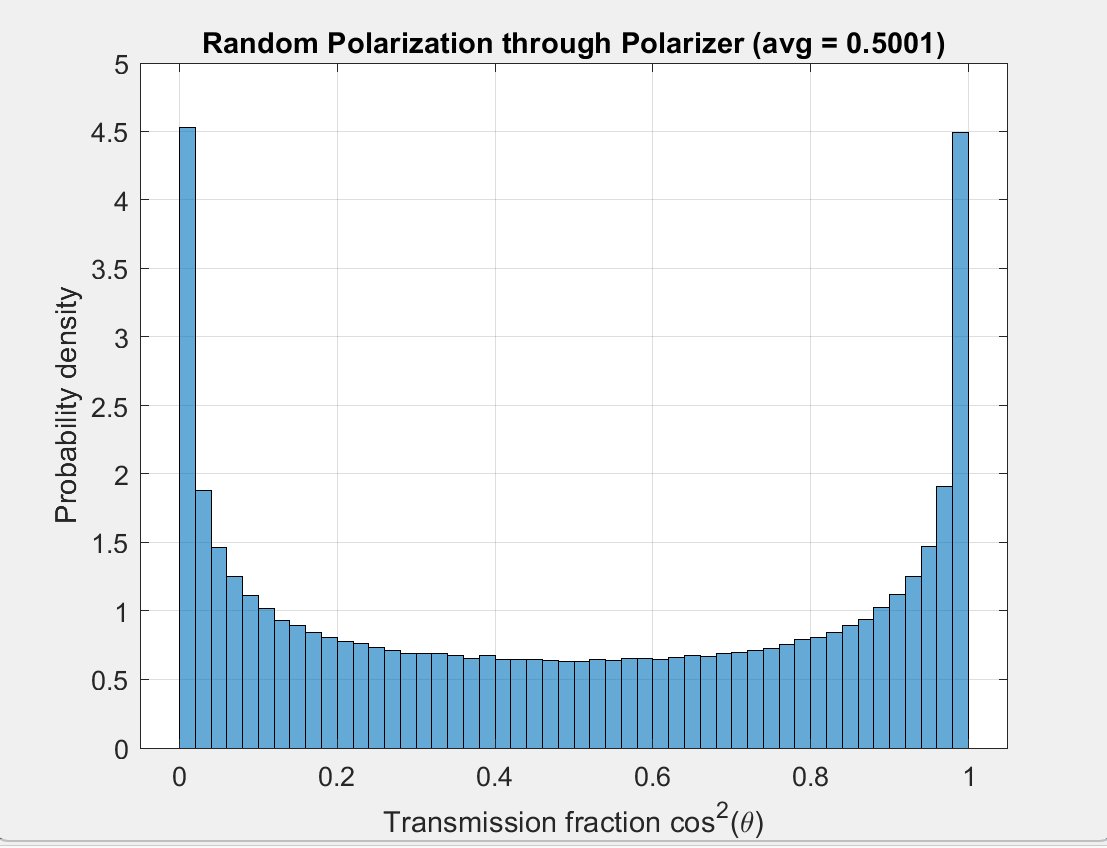
MATLAB source: Monte Carlo polarization
% Task 3: Power transmitted through polarizer for random polarization
N = 1e6;                          % number of samples
theta = 2*pi*rand(N,1);           % uniform random angles in [0, 2pi]
T = cos(theta).^2;                % Malus's law transmission
avg_transmission = mean(T);       % average power fraction
fprintf('Average transmission = %.4f (expected 0.5)\n', avg_transmission);

figure;
histogram(T, 50, 'Normalization', 'pdf');
xlabel('Transmission fraction cos^2(\theta)');
ylabel('Probability density');
title(sprintf('Random Polarization through Polarizer (avg = %.4f)', ...
      avg_transmission));
grid on;
Task 4: Modulation and end-to-end link
Full binary link: 5 mW laser at \(\lambda = 1.55\ \mu\mathrm{m}\) → vertical polarizer → electro-optic modulator (\(V_\pi = 5\ \mathrm{V}\)) → quarter-wave plate → horizontal polarizer → multimode fiber → PIN photodiode (\(\eta_q = 80\%\)).
| Bit | Drive | Transmission | Optical power | Photocurrent |
|---|---|---|---|---|
| '1' | +2.2 V | 0.9900 | 2.477 mW | 2.44 mA |
| '0' | −2.2 V | 0.00886 | 22.1 µW | 21.8 µA |
At 50 Mbps the intermodal dispersion budget allows a maximum fiber length of ≈ 297.9 m (delay per unit length 33.56 ns/km, half-bit-period criterion). Photodiode responsivity worked out to 0.998 A/W.